| CVE | CVE-2024-22013 |
|---|---|
| Affected | Google Wifi Pro, firmware ≤ 3.73.406133 |
| Discovered by | Raelize (and Sergei Volokitin) |
| Timeline | Reported to Google in April 2024 |
| Presented | OffensiveCon 2026 (Raelize) / hardwear.io 2024 (Sergei) |
| Severity | High |
| CVSS 3.1 | 6.8 (AV:P/AC:L/PR:N/UI:N/S:U/C:H/I:H/A:H) |
| CWE | CWE-347 Improper Verification of Cryptographic Signature |
| Fixed | Yes, in 3.74.442328 |
Summary
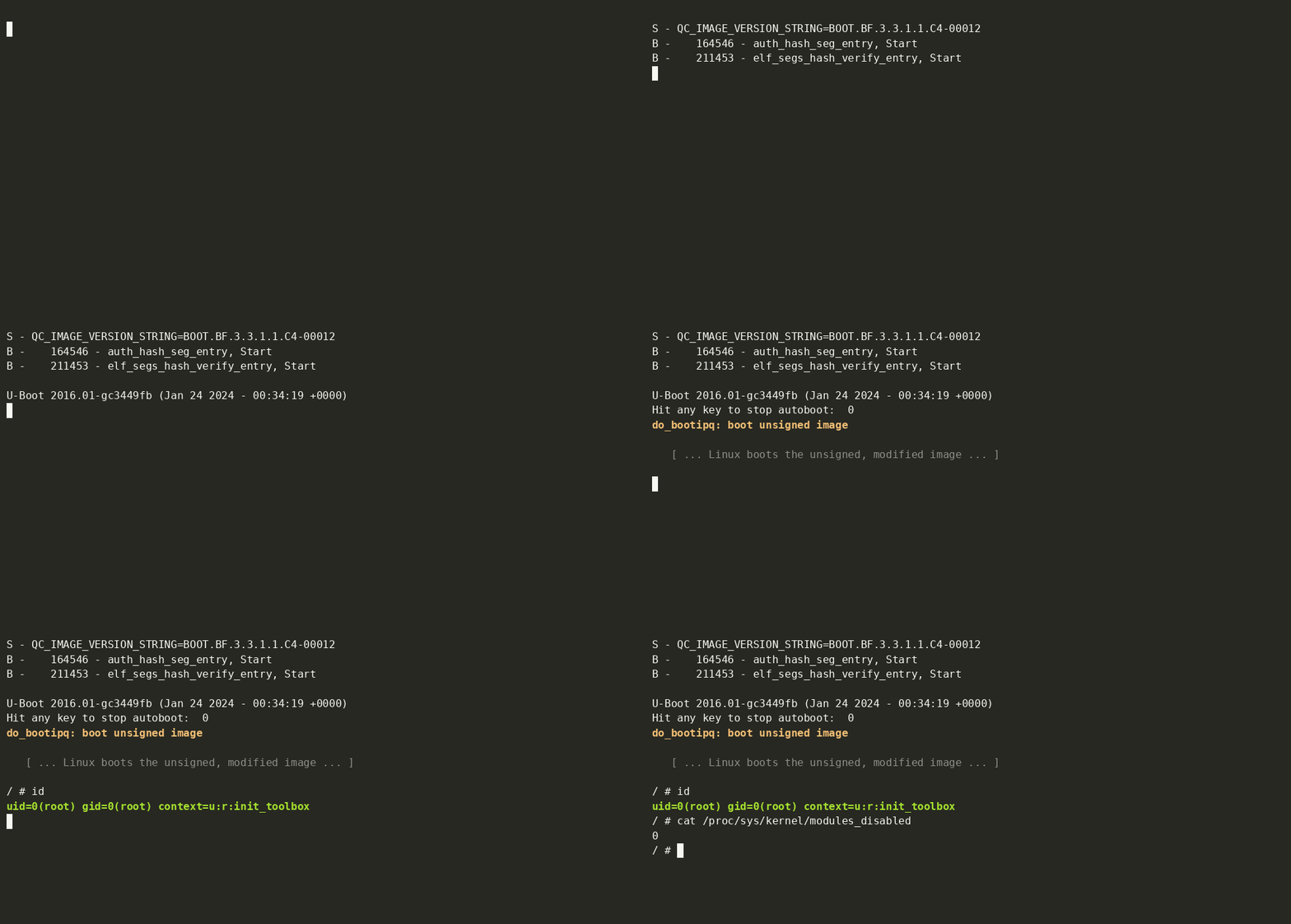
U-Boot on the Google Wifi Pro loads its environment from an eMMC partition (ubootenv / 0:APPSBLENV) that is not part of the signed image and is not authenticated. An attacker with eMMC write access adds that partition, sets the atf variable, and U-Boot then boots an unsigned kernel + initrd. A modified init.rc yields a persistent root shell. Only the non-secure chain (U-Boot → Linux) is bypassed; SBL1/QSEE/U-Boot images stay authenticated, but this foothold is the pivot for all later TrustZone work.
Root cause
Two weaknesses combine. First, U-Boot looks up an environment partition by name and trusts whatever CRC-valid image it finds there, and nothing signs or verifies it:
/* bootloader/board/qca/arm/common/env.c (GPL source, 3.73.406133) */
ret = get_partition_info_efi_by_name(blk_dev, "0:APPSBLENV", &disk_info);
if (ret)
    ret = get_partition_info_efi_by_name(blk_dev, "ubootenv", &disk_info);
if (ret == 0) { board_env_offset = disk_info.start * disk_info.blksz; ... }
Second, an environment variable turns off kernel authentication outright:
/* bootloader/board/qca/arm/common/cmd_bootqca.c, do_bootipq() */
if (ret == 0 && buf == 1 && !getenv("atf")) {
    ret = do_boot_signedimg(...);      /* "boot signed image" */
} else {
    ret = do_boot_unsignedimg(...);    /* "boot unsigned image" when atf is set */
}
So an attacker-supplied ubootenv with atf=1 routes boot to the unsigned path.
Proof of concept
Impact
Persistent root (NS-EL1, unsigned kernel) on any unit with physical eMMC access.
Mitigation
Fixed in 3.74.442328 by removing the ubootenv/APPSBLENV partition lookup (i.e., the default environment is used).
References
- CVE-2024-22013 (NVD)
- Nest Security Bulletin, September 2024
- “Google Nest Wifi Pro: Bypassing Android Verified Boot”, Sergei Volokitin, hardwear.io. A public presentation of a Verified Boot bypass on this device. Raelize independently discovered this issue and reported it to the vendor in April 2024, ahead of that public disclosure.
- “EL3vated Privileges: Glitching Google Wifi Pro from Root to EL3”, Raelize, hardwear.io USA 2025. The first time we mentioned this issue, as the starting point for our fault injection work.
- “Exploiting QSEE Vulnerabilities in Google Wifi Pro”, Raelize, OffensiveCon 2026. Explains our exploit.
Feel free to reach out if you have any questions and/or remarks.
- Raelize.